


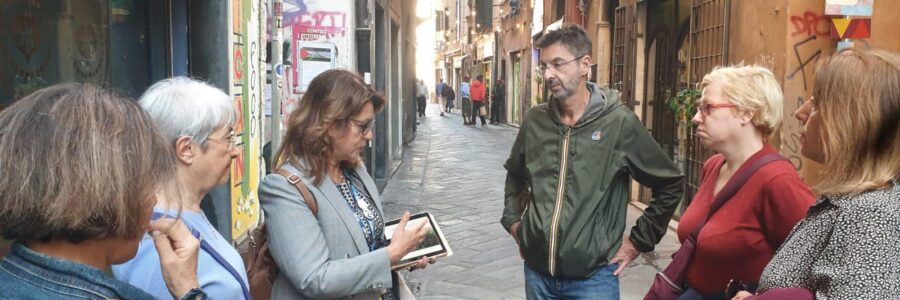
On the occasion of Indigenous Peoples’ Day, Migrantour Genoa organized an intercultural walk on Saturday, 11 October 2025. Led by intercultural guides and citizens of migrant origin, the tour made it possible to explore Genoa’s Historic Centre, rediscovering not only its rich historical and artistic heritage but also the many cultural realities that today make it vibrant and dynamic.
The Migrantour Genoa itineraries, curated by the Solidarietà e Lavoro Cooperative in collaboration with Castello D’Albertis – Museum of World Cultures, were created to promote a new idea of intercultural tourism. This approach helps us understand how our city has always been shaped by migration and by encounters between different cultures, allowing us to discover neighborhoods undergoing urban regeneration and characterized by the active presence of foreign communities.
The walk on 11 October fits into a particularly topical debate, at a historical moment in which many museums are embarking on an important process of decolonization. This route begins with a critical and informed analysis of the colonial roots of museum institutions, which were founded in eras that today require a profound re-reading. Acknowledging this past is essential to initiate transformations capable of reconnecting museums with the urgencies of the present, responding to pressing—and now unavoidable—demands for social and environmental justice.
Why, today, do many Latin American countries celebrate Indigenous Peoples’ Day and not 12 October? This and other questions were the guiding thread of the route through the Sestiere of Pré, starting at the Monument to Christopher Columbus and ending at the Church of San Siro. The focus was the Columbian voyage, explored through the testimonies of foreign communities present in the area, in order to understand the impact that Cancel Culture has had in their countries of origin.
Legends, histories of exchange, recipes, and first-hand testimonies shed light on the historical processes experienced under the exaltation of the figure of Christopher Columbus, up to his decline as an icon.